Confirm it's off
The burst line is isolated so the plumbing repair can follow and the rest of the house can get water back.
When a pressurized line lets go, hundreds of gallons can come through the ceiling before anyone reaches the shut-off. A water damage contractor gets the standing water out, sorts what can be saved from what can't, and starts drying as soon as possible.
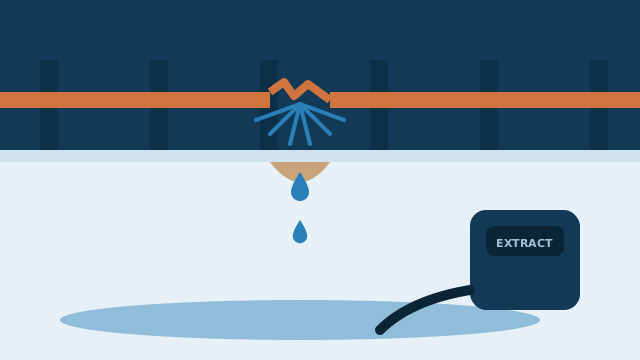
Extraction is the fastest drying there is. Every gallon pulled out as water is a gallon that doesn't have to be evaporated out of the house.
The burst line is isolated so the plumbing repair can follow and the rest of the house can get water back.
Water trapped above the drywall is drained in a controlled way, and sagging sections are taken down safely.
Floors, carpet and the ceiling cavity cleared of free water with extraction equipment.
Soaked insulation, carpet pad and drywall that can't be dried are removed; everything else is set up to dry.
Dehumidifiers and air movers placed the same day, with the first moisture readings recorded.
Burst supply lines carry clean water, which is the best case. Speed and where the water went decide the rest.
| Material | Usually | Why |
|---|---|---|
| Ceiling drywall, firm and flat | Dry in place | Clean water, caught fast, still structurally sound |
| Ceiling drywall, sagging or soft | Replace | Wet gypsum that has sagged doesn't regain its strength |
| Attic or ceiling insulation | Remove | Holds water against the drywall and dries very slowly; see wet insulation removal |
| Carpet | Often dried | If extracted quickly and the water was clean |
| Carpet pad | Usually replaced | Absorbs and holds water, hard to dry thoroughly |
| Baseboards and wall bottoms | Depends | Readings decide; sometimes a short cut at the bottom of the wall lets the cavity dry |
Extraction is day one. After that, the job moves through the same stages as any water loss:
If the leak was a slow weep rather than a sudden burst, start with ceiling pipe leak repair instead.
What to do now, and what happens next.
Shut off the main water valve, then open a faucet on the lowest floor to drain pressure from the lines. Turn off the breaker for any room where water is reaching lights, outlets or the ceiling. Get people and pets away from any bulging ceiling. Then call, and take photos while you wait.
Usually where the water line enters the house, often near the front hose bib, in the garage, or along the side of the house closest to the street. If you can't find it, the curb valve at the meter can shut the house off, but it may need a meter key.
As fast as possible. Standing water keeps soaking into drywall, baseboards, cabinets and subfloor every hour it sits, and the EPA's guidance is to dry water-damaged materials within 24 to 48 hours to prevent mold. Getting the standing water out is what makes drying possible.
Often, if the water was clean and it's extracted and dried quickly. The pad underneath is a different story: it soaks up water like a sponge and is usually replaced. Water that came through a ceiling may have picked up dirt and insulation, which can change what's worth saving.
In Diamond Bar, bursts are rarely from freezing. They usually come from corroded copper that finally gives way, a failed fitting or valve, a braided supply hose to a toilet, sink or washer, water heater connections, or high water pressure stressing an older system.
A sudden burst is the kind of event most homeowners policies cover, minus your deductible. The failed pipe itself usually isn't. Read how California policies treat water damage.