Does Homeowners Insurance Cover Water Damage in California?
Sometimes. Whether your policy pays for water damage, including a damaged ceiling, usually comes down to one question: was it sudden, or did it happen over time? Here's how California policies treat ceiling leaks, and what protects your claim.
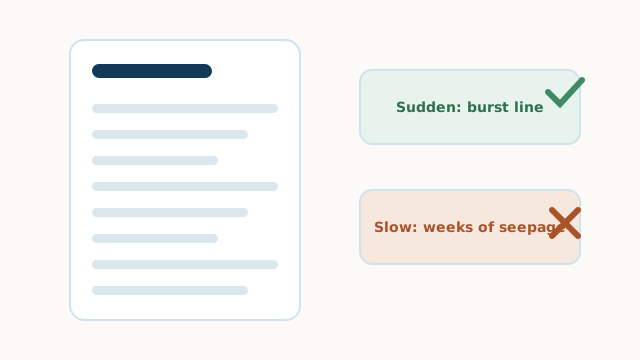
Most California homeowners policies cover ceiling water damage from sudden, accidental events like a burst pipe or a failed supply line, minus your deductible. They commonly exclude damage from slow leaks that went on over time, from wear and tear, and from poor maintenance. A standard California FAIR Plan policy on its own doesn't cover water damage. Policies differ, so your declarations page and exclusions are the final word.
Not legal or insurance advice. This is general information from a contractor who works on these claims. For your specific policy, talk to your agent, your insurer, a public adjuster or an attorney.
Sudden vs. gradual: the question that decides most claims
| Cause | Typical treatment |
|---|---|
| Supply line or fitting bursts | Usually covered: sudden and accidental |
| Water heater or washer hose fails | Usually covered for the resulting damage |
| Toilet or tub overflows | Often covered; contamination may affect the scope |
| AC drain clogs and overflows | Depends: a sudden overflow vs. a pan that rusted and dripped for weeks |
| Shower pan or wax ring leaking for months | Often denied under the seepage or wear exclusions |
| Roof leak after wind or storm damage | Often covered when a covered peril created the opening |
| Roof leak from an old, worn roof | Often denied as wear or lack of maintenance |
| Mold from any of the above | Often limited or excluded; check your policy's mold provision |
The "continuous or repeated seepage" exclusion
Nearly every California homeowners policy has some version of it: damage from water that leaked or seeped continuously or repeatedly over a period of time isn't covered. Older forms often spelled out 14 days or more; many current policies just say "over a period of time."
In practice, it's the reason many ceiling claims are denied. An insurer sees rings on the drywall, corrosion on a pipe or rot in a subfloor and concludes the leak was long-running.
California courts have pushed back when the evidence doesn't support that. In May 2026, the state's Second District Court of Appeal reversed a judgment for State Farm in Nargizyan v. State Farm General Insurance Co., finding there were real factual disputes about whether a burst pipe leak was continuous or repeated, and that the insurer had to support its denial with evidence. Every case turns on its own facts, but the takeaway for homeowners is clear: what you document matters.
What a covered claim usually pays for, and what it doesn't
Usually included
- Drying and water removal (mitigation)
- Removing and replacing damaged drywall and insulation
- Tearing out and putting back parts of the house to reach the leak
- Texture matching and repainting, so the repair matches
- Damaged belongings, under your personal property coverage
- Additional living expenses if the home is unlivable, where your policy includes them
Usually not included
- The failed part itself: the worn pipe, shower pan, water heater or roof
- Damage that got worse because nothing was done to stop it
- Upgrades beyond like kind and quality
How to protect your claim from day one
- Stop the water and prevent more damage. Policies require reasonable steps. Waiting for an adjuster before drying can hurt you.
- Photograph and video everything before anything is moved: the ceiling, the source, the room and belongings.
- Write down when you first noticed it and what you saw. That timeline matters for the seepage question.
- Keep the failed part if one is removed: the burst hose, the cracked fitting, the section of pipe.
- Get the cause in writing from whoever finds it, with photos from inside the ceiling.
- Report promptly and keep a log of every call, with names and dates.
The insurance claim help page covers the documentation to ask for: dated photos, the moisture log and a line-item estimate. For the full checklist, see how to document water damage for insurance, and if the repair is small, whether to claim or pay yourself.
Your claim-handling rights in California
California's Fair Claims Settlement Practices Regulations set deadlines insurers must follow. In general:
- 15 days to acknowledge your claim after notice, and to respond to your communications.
- 40 days after receiving proof of claim to accept or deny it, in whole or in part, or explain in writing why more time is needed, with updates every 30 days.
- A written denial that cites the specific policy provisions relied on.
If you think a claim is being handled unfairly, the California Department of Insurance takes consumer complaints.
Special cases: FAIR Plan and condos
California FAIR Plan. A standard FAIR Plan policy covers fire and a few named perils, not water damage. You need a separate Difference in Conditions policy for that, and the rules are changing in 2026. See California FAIR Plan and water damage.
Condos and townhomes. Your HO-6 policy, the HOA's master policy and your neighbor's policy may all be involved. See condo leak from the unit above: who pays?
Insurance and ceiling water damage: questions
Coverage, exclusions and deadlines in California.
Does homeowners insurance cover a leaking ceiling in California?
Often, if the water came from a sudden, accidental event, such as a supply line that burst or a fitting that failed without warning. Damage from slow leaks that went on for weeks, from wear and tear, or from maintenance problems is commonly excluded. The cause decides the claim more than the damage does.
What is the continuous or repeated seepage exclusion?
It's language found in nearly every California homeowners policy that excludes damage caused by water leaking or seeping over a period of time. Some policies define the period, often 14 days or more; others just say "over a period of time." Insurers rely on it to deny many ceiling claims, so what happened, and when, matters.
Does insurance pay to fix the pipe or the roof that leaked?
Usually not the failed part itself. Policies generally pay for the resulting damage, like the ceiling, insulation and paint, and often for tearing out and replacing parts of the house needed to reach the leak. The worn-out pipe, shower pan or roof is typically your cost.
Is a roof leak covered?
It depends on why the roof leaked. If a storm or wind created an opening, such as tiles lifted by a Santa Ana wind event, the interior damage that follows is often covered. If the roof simply wore out, insurers commonly deny it as wear, deterioration or lack of maintenance. Check your policy's wording on both.
How long does my insurer have to respond to my claim in California?
Under California's Fair Claims Settlement Practices Regulations, an insurer generally has to acknowledge a claim within 15 calendar days of notice and accept or deny it within 40 days of receiving proof of claim. If it needs more time, it has to tell you in writing why, and update you every 30 days.
Should I file a claim for a small ceiling repair?
Compare the estimate to your deductible first, then talk to your agent about how a claim may affect your premium or renewal. For a repair that's close to the deductible, many homeowners pay themselves. The cost page explains what drives the price.