The stain and the timing
Shape, color and rings show how long it's been going and whether it's spreading. The key question is when it changes: after rain, showers, laundry, flushing, or on hot days when the AC runs.
A stain with no obvious cause is the most frustrating kind. Hidden ceiling leaks are traced with moisture readings, simple isolation tests and one small, deliberate opening, so the repair fixes the cause and not just the spot.
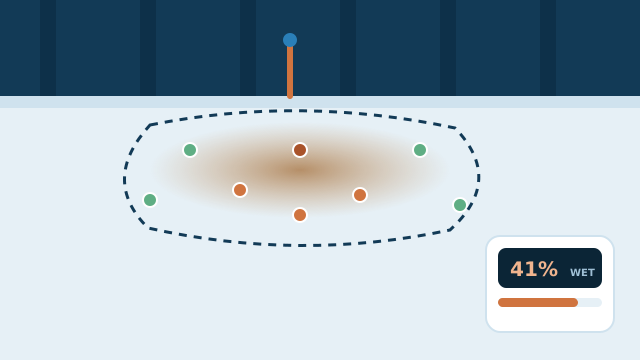
Water travels before it shows up. It runs along a pipe, follows the top of a joist, soaks into insulation and finally drops through the drywall wherever there's a seam, a light fixture or a low point. In a Diamond Bar two-story built in the '80s, a shower valve leak can show up six feet away over the dining room.
Professional ceiling leak detection means mapping where the drywall is wet, working out when it gets wetter, and testing each possible source in turn, then confirming the source with one small inspection opening before anything else is cut.
That's why cutting a big hole under the stain is the wrong first move. It's expensive, it often misses, and it makes the repair bigger than it needs to be. What you want is a map of the wet area and a reason for every opening.
Each step rules something in or out. Most leaks are found by step four.
Shape, color and rings show how long it's been going and whether it's spreading. The key question is when it changes: after rain, showers, laundry, flushing, or on hot days when the AC runs.
Pinless and pin moisture meters across the ceiling, compared against a dry ceiling elsewhere in the house. The wettest point is rarely the center of the stain.
Everything off, then watch the leak indicator on your Walnut Valley Water District meter. If it moves, water is escaping somewhere on the pressurized lines.
Shower, tub, toilet, sinks, washer, water heater and the AC drain are run or tested separately while the ceiling is watched and re-measured.
Where there's attic access, the insulation, the AC pan and line, bath fan ducts, water heater and roof penetrations directly above the wet area get checked.
A clean square cut at the highest reading, with the floor covered. The pipe, drain or joist can be seen directly and photographed, and the piece kept when it can be reused.
| Source | What gives it away | Where to read more |
|---|---|---|
| Shower valve, pan or drain | Wetter after showers; often in two-story homes where the bathroom sits over a living area | Bathroom leaks |
| Pinhole in a copper supply line | Wet all the time, meter moving, bill going up; common in homes with original copper | Pipe leaks |
| AC condensate line or pan | Only in cooling season, near the air handler, return grille or attic hatch | AC leaks |
| Bath fan duct condensation | Drips around the fan grille after long hot showers, worse on cool mornings | Light & fan leaks |
| Washer hoses, water heater, fridge line | Stain under a laundry closet or upstairs utility area | Emergency steps |
| Roof, flashing or window | Only after rain, often near an outside wall, chimney or skylight | Roof leak detection |
Once the source is confirmed, you get it in writing with photos: what failed, where, and how the water reached the ceiling. That matters if you're filing a claim, because insurers look closely at whether a leak was sudden or gradual.
What people ask when the stain doesn't explain itself.
The search starts from the outside in: the stain's shape and timing, moisture readings across the ceiling, a water meter check and running each fixture above one at a time. That usually narrows it to a small area. Only then is a neat inspection hole opened, normally a square that can be reused as the patch, right where the readings are highest.
Not directly. A thermal camera shows temperature differences on the surface, and wet drywall often reads cooler because water is evaporating from it. It's a good way to see the shape of a wet area, but cold air from a duct or a missing patch of insulation looks similar. What a thermal image suggests should be confirmed with a moisture meter before anyone cuts.
Often, yes. Old water leaves clues: tide-line rings, stained framing, minerals on a pipe joint, a compressed spot in the insulation. But an intermittent leak is easiest to catch when it's active, so the contractor may ask you to call when the stain darkens again, or recreate the conditions: run the shower, the washer or the AC.
Timing usually answers it. A stain that only changes after rain points to the roof, flashing or a window. One that changes when it hasn't rained, especially after showers, laundry or on hot afternoons with the AC running, points to plumbing or the AC drain. If it's clearly rain-related, see the roof leak detection page.
If the water meter test shows a leak but nothing turns up above the ceiling, the leak may be in a wall, under the slab or on the line from the meter. Pinpointing those takes acoustic and pressure testing by a plumbing leak-detection specialist. A good contractor will say plainly when that's the next step instead of opening more ceiling.
Ask the contractor to explain the inspection and any opening before they start, and for a written estimate once the source is known. Finding the cause should be part of every ceiling job, because a patch over an active leak is money thrown away.