Classic water stain
Concentric rings mean the area got wet and dried more than once. The outer ring marks how far the water spread the last time.
An old water stain is the leak's last word, and it doesn't go away on its own. The ceiling is confirmed dry, the stain sealed with a primer that actually blocks it, and the ceiling repainted.
A lot of stained ceilings don't need new drywall at all. The leak was fixed months ago, the drywall dried out, and what's left is a cosmetic ring that keeps showing through whatever someone painted over it. That's a stain repair, one of the smaller ceiling jobs.
the leak has been fixed, moisture readings are back to normal, the drywall is firm when you press it, there's no sag, crack or bubbling, and no musty smell. If any of those fail, the ceiling needs more than paint.
Not sure whether your stain is old or active? The guide on whether a water stain is dangerous walks through the checks.
Concentric rings mean the area got wet and dried more than once. The outer ring marks how far the water spread the last time.
A soft yellow patch with no hard edge often comes from a slow, long-ago leak, or from residue bleeding through layers of paint.
Small orange or brown dots in a row are drywall nails or screws that got wet and rusted. They bleed through just like a stain.
Fuzzy or speckled dark spots aren't a stain repair. Painting over mold hides it, it doesn't stop it. See ceiling mold removal.
Most Diamond Bar homes from the '70s through the '90s have textured ceilings: knockdown, orange peel, or acoustic popcorn in the older and attached homes. Primer and paint behave differently on each. Heavy primer can flatten a knockdown pattern, and too much roller pressure can pull orange peel off. On an older popcorn ceiling, the first question is whether it's been tested.
When the stain sits on a textured ceiling, the texture is matched where the primer has softened it before the final coat. If the stain is part of a larger repair, the texture work is covered on the ceiling texture matching page.
Why stains come back, and how to make them stay gone.
The brown ring is made of minerals and residue the water carried out of the drywall, wood and insulation. Ordinary latex paint is water-based, so it re-dissolves those deposits and pulls them right back through to the surface. The stain needs a stain-blocking primer first, one made to lock it in, and then the finish coat.
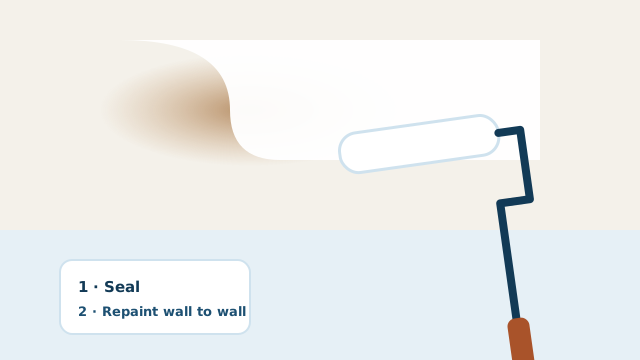
The stain is primed, then the ceiling repainted wall to wall. Ceiling paint fades and yellows over the years, so a fresh patch of the same color stands out as a brighter square. Painting the whole ceiling, corner to corner, is what makes the spot blend in.
Measure. A moisture meter on the stain and on a dry part of the same ceiling shows whether the drywall is still wet. If the readings are elevated, or the stain has a darker, damp-looking center, the source has to be found before anything gets painted.
Sometimes, with care. Acoustic texture soaks up primer and paint and can loosen when it gets wet, and in older homes it should be tested for asbestos before it's disturbed. See the popcorn ceiling repair page for the options.
No. Soft, crumbly or sagging drywall has lost its strength, and paint won't fix that. That section gets cut out and replaced, then finished, textured and painted. See ceiling drywall repair.
It can. Homes built before 1978 may have lead in older paint layers. Lightly priming and repainting over intact paint doesn't disturb much, but sanding, scraping or cutting out painted drywall does, so lead-safe work practices apply on older ceilings when the job calls for it.