Condo Leak From the Unit Above: Who Pays in California?
Water coming through your condo ceiling raises two questions at once: who fixes the leak, and who pays for your ceiling? In California the answers start with Civil Code § 4775 and end with your CC&Rs. Here's how it usually works.
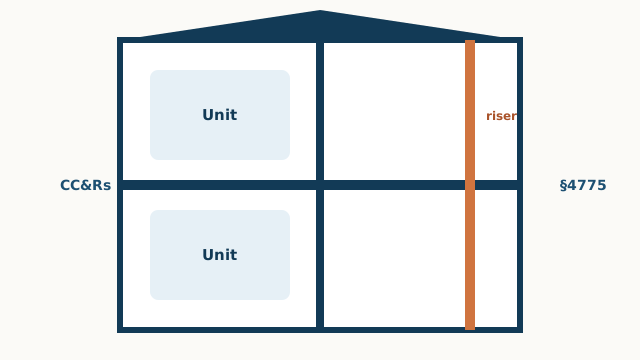
Under California's default rule (Civil Code § 4775), the HOA repairs common areas like shared pipes and the roof, and owners maintain their own units, unless the CC&Rs say otherwise. So a leak from your neighbor's toilet or washer is usually theirs to fix, and a leak from a shared riser or the roof is usually the association's. Who pays for your damaged ceiling depends on your CC&Rs, any negligence, and the insurance policies involved.
Not legal advice. This is a general overview from a contractor who repairs these ceilings. Your CC&Rs control, and for a dispute, talk to an attorney who handles community association law.
The default rule: Civil Code § 4775
California's Davis-Stirling Common Interest Development Act sets default repair and maintenance responsibilities that apply unless your association's declaration (the CC&Rs) says otherwise:
| Area | Examples | Default responsibility |
|---|---|---|
| Common area | Roof, exterior walls, shared risers and main lines, structure | Association repairs, replaces and maintains |
| Separate interest (your unit) | Fixtures, appliances, interior finishes, plumbing serving only your unit | Owner maintains |
| Exclusive use common area | Balconies, patios, doors and windows, depending on the documents | Owner maintains; association repairs and replaces |
The condominium plan and CC&Rs define where your unit ends. In many California condos, the unit is the airspace and interior surfaces, while the framing and the pipes in the walls between units are common area. In many townhome communities, owners own more of their structure. That's why the documents matter more than the label.
Where the water started decides who fixes the source
- Neighbor's fixture or appliance (toilet, shower pan, washer hose, water heater, dishwasher): usually the neighbor's responsibility.
- A pipe that serves only their unit: often theirs, depending on whether it's inside their unit boundaries.
- A riser or main line serving several units: usually common area, the association's.
- The roof, exterior walls or windows: usually common area or exclusive use common area, the association's to repair.
- A balcony or deck over a living space: often exclusive use common area; check the documents.
Pinning down the source in writing is the first thing that moves a condo leak forward. It's also why it helps to have the contractor photograph what's inside the ceiling and put it in a short written finding everyone can see. See condo ceiling leak repair.
Who pays for the damage to your ceiling
Fixing the source and paying for the damage are two separate questions. Three things decide the second one:
1. Your CC&Rs
Many CC&Rs say each owner is responsible for damage to their own unit's interior regardless of cause, and expect owners to insure it. Others shift that to the association when a common-area failure caused it.
2. Negligence
If someone caused the leak by doing something careless or ignoring a problem, such as a neighbor who left a tub running or an association that ignored repeated roof-leak reports, that party may be liable for the damage, whatever the default rule says.
3. Insurance
In practice, most condo leaks are resolved by insurance companies. Your HO-6 covers your interior and belongings, the HOA's master policy covers what it covers, and insurers then sort out reimbursement among themselves.
What to do, in order
- Stop the water. Contact the unit above and the HOA's emergency line. Shared shut-offs are often the association's.
- Make it safe. Breaker off for wet lights; keep clear of any bulge.
- Document. Time-stamped photos and video, and notes of who you spoke to and when.
- Notify in writing. A short email to your neighbor and the management company, with photos, the same day.
- Call your own insurance agent. Your HO-6 may respond regardless of fault.
- Get the source identified in writing. It's the fact everyone's responsibility hinges on.
- Read your CC&Rs, especially the maintenance, insurance and damage sections.
- Don't wait on the dispute to dry the ceiling. Mold and further damage make everyone's costs higher.
HO-6 and master policies
Associations have to give owners an annual summary of their insurance. Read it next to your HO-6 policy. Some master policies cover the building's structure only, sometimes called bare walls. Others include original interior finishes, sometimes called walls-in. The difference decides how much interior coverage you need on your HO-6, and whether your loss assessment coverage is high enough if the association passes a deductible on to owners.
For how policies treat the cause of a leak, see does insurance cover ceiling water damage in California.
Diamond Bar condos and townhomes
Diamond Bar has many attached-home communities, from the condos and townhomes along Diamond Bar Boulevard and Golden Springs Drive to Cimmaron Oaks and gated communities with their own associations. Each has its own CC&Rs, its own management company and its own rules for access and contractors. Older attached homes may also have popcorn ceilings, which don't get the single-family exemptions in South Coast AQMD's asbestos rule. See popcorn ceiling repair.
Condo leak responsibility: questions
Civil Code § 4775, CC&Rs and insurance.
Who is responsible for a leak from the condo above in California?
It depends on where the water started and on your association's CC&Rs. By default, California Civil Code § 4775 makes the HOA responsible for common areas and each owner responsible for their own unit. If the leak started in your neighbor's unit, their fixture or appliance is usually theirs to fix. If it started in a shared riser or the roof, it's usually the association's. Your governing documents can change those defaults.
Does the HOA have to fix my ceiling?
Not automatically. Responsibility for fixing the source and responsibility for repairing the damage in your unit aren't always the same thing. Many CC&Rs make owners responsible for their unit's interior, including drywall, regardless of the cause. Others make the association responsible when a common-area component caused the damage. Read the maintenance and insurance sections of your CC&Rs.
Is my upstairs neighbor liable for water damage to my unit?
They can be, especially if the damage came from something they did or failed to maintain, such as an overflowing tub or a washer hose they knew was leaking. Even then, it's usually handled through insurance: your HO-6 pays for your unit and may seek reimbursement from your neighbor's insurer.
What is an exclusive use common area?
Part of the common area that's set aside for one owner's use, like a balcony, patio, or the doors and windows of a unit, depending on the documents. Under the default rule, the owner maintains it and the association repairs and replaces it, unless the CC&Rs say otherwise. Leaks from balconies and decks over a living space often fall here.
Who pays if I have to move out during repairs?
Under § 4775, when the association is repairing areas it's responsible for, the cost of the owner's temporary relocation is the owner's unless the governing documents provide otherwise. Your HO-6 policy may include loss-of-use coverage for that. Check before you book a hotel.
What insurance do I need as a condo owner?
Usually an HO-6 policy covering your unit's interior, your belongings, liability and often loss of use and loss assessments. How much interior coverage you need depends on what the HOA's master policy covers, so ask for the association's insurance summary and compare.