Mold Growth After a Leak: How Fast Does It Start?
Faster than most people expect, and usually where you can't see it. Here's the timeline, what speeds it up inside a ceiling, how to check for hidden growth, and when cleanup is a homeowner job.
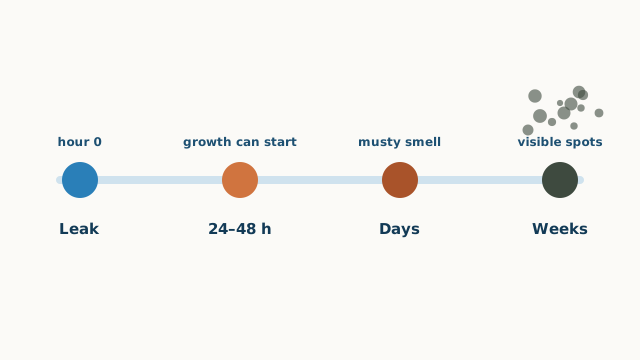
Mold can start growing on wet drywall, wood and insulation within 24 to 48 hours. That's why the EPA says water-damaged materials should be dried within that window. Inside a ceiling, growth usually starts on the hidden side and may not show for days or weeks. Stop the water, open and dry the area quickly, and remove any material that stayed wet too long.
The mold timeline after a ceiling leak
| Time since the leak | What's happening | What to do |
|---|---|---|
| 0–24 hours | Drywall, insulation and framing absorbing water; mold spores already present start to activate | Stop the source, remove standing water, start drying |
| 24–48 hours | The window in which growth can begin on wet porous materials | Open the cavity, pull wet insulation, dehumidify |
| Days | Growth established on the back of the drywall and in insulation; musty smell may start | Inspect; remove affected materials under containment |
| Weeks | Spots may show on the room side, paint bubbles, drywall softens | Remediation and rebuild; find out why it stayed wet |
These are typical patterns, not exact clocks. Temperature, the type of water and how much air can reach the wet area all shift them.
Why ceilings grow mold faster than you'd think
- The water sits on top. It pools on the back of the drywall and in insulation, exactly where you can't see or reach it.
- No airflow. A ceiling cavity is dark and still. Without air movement, it stays humid long after the drip stops.
- Food is built in. Drywall paper, wood framing and household dust are all things mold feeds on.
- Warmth. Mold grows faster when it's warm. Diamond Bar's attics heat up quickly, and a wet cavity in summer is close to ideal.
- Repeated wetting. Intermittent leaks, like a shower pan, AC line or storm-only roof leak, re-wet the same spot before it ever fully dries.
How to check for hidden mold in a ceiling
- Use your nose. Stand under the stain and in the closets nearby. A musty, earthy smell is the most common early sign.
- Look at the surface. Speckled grey, black or green spots, paint bubbles, or a stain with a darker, damp-looking center.
- Look from above. If there's attic access, check the insulation over the wet area for dark, matted or clumped spots, and the joists for discoloration.
- Open a small inspection hole. The most direct check. If the back of the paper or the insulation is discolored, that section comes out.
When is mold cleanup a homeowner job?
The EPA's general rule is that areas under about 10 square feet can often be handled by a homeowner, with gloves, eye protection and an N-95 respirator, as long as the water problem is fixed. Hard surfaces can be scrubbed with detergent and water and dried. Porous materials like drywall and insulation that are moldy are usually removed rather than cleaned.
Call a professional when:
- The area is larger than about 10 square feet, or you can't see how far it goes
- The water was sewage or otherwise contaminated
- Mold may be in the HVAC ducts or the air handler
- Anyone in the home has asthma, allergies or a weakened immune system
The ceiling mold removal page explains how containment, removal and rebuilding work.
How to keep a leak from turning into a mold job
- Stop the water the moment you find it, even if the repair waits.
- Don't wait for the adjuster to start drying; take photos and get started.
- Get wet insulation out from above the ceiling.
- Run a dehumidifier, not just fans.
- Confirm dryness with readings before closing anything up.
Deciding what to keep and what to remove is covered in wet ceiling drywall: dry it or replace it?
Mold after a leak: questions
Timing, hidden growth and testing.
How long after a leak does mold grow?
Mold can begin growing on wet materials within 24 to 48 hours, which is why the EPA advises drying water-damaged materials in that window. Visible spots usually take longer, often days to weeks, and inside a ceiling cavity you may not see anything on the room side until it's well established.
If I dried it within 48 hours, am I safe?
Usually, but it's a guideline, not a guarantee. If the drywall's surface dried but the insulation and the top side stayed damp, growth can still start. The real question is whether everything that got wet actually dried, and that's best checked with a moisture meter.
Can mold grow in a ceiling without any visible signs?
Yes. Ceiling mold typically starts on the back of the drywall, on joists or in insulation, out of sight. A musty smell, a stain that stays damp, or paint that bubbles are often the first clues. A small inspection opening is the most direct way to check.
Does Southern California's dry weather slow mold down?
It helps once a wet area is opened and exposed to dry air. But inside a closed ceiling, conditions are local: dark, still and humid from the water itself. Warm Diamond Bar temperatures can actually speed growth inside a wet cavity.
Is it safe to stay in the house with mold in the ceiling?
For most healthy people, a small area of mold behind a ceiling isn't an emergency, but it should be fixed promptly. People with asthma, allergies, weakened immune systems, infants and older adults are more sensitive. If anyone has symptoms, keep them out of the area and talk to a doctor.
Should I test for mold after a leak?
Testing isn't usually needed when the leak and the wet area are known; the fix is the same either way. It's useful for hidden growth you suspect but can't see, health concerns, or when a buyer, tenant or HOA wants independent documentation.