How to Find Where a Ceiling Leak Is Coming From
Before anyone cuts a hole, you can usually narrow a ceiling leak down to one or two sources yourself. Here's a sensible order: read the stain, check the timing, test the meter, look above, then test fixtures one at a time.
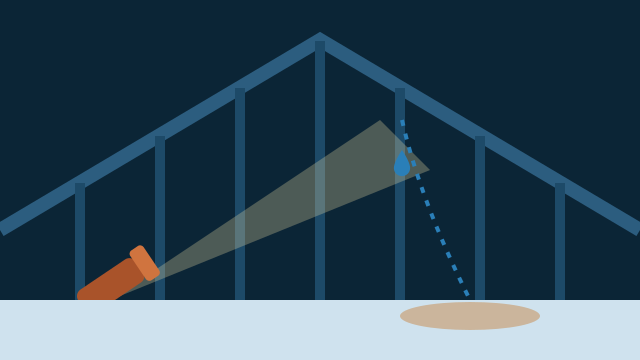
Start with when the stain appears: during rain points to the roof; after showers or flushing points to the bathroom above; on hot days points to the AC drain; all the time points to a supply pipe. Confirm with the water meter test, a look in the attic or the room above, and by running one fixture at a time while someone watches the ceiling.
Step 1: Read the stain
Before you do anything else, take a photo of the stain and mark its edge lightly in pencil with the date. That gives you a baseline to see whether it's growing.
- Where is it? Near an outside wall, chimney or skylight suggests the roof. Under a bathroom or laundry suggests plumbing. Near a supply vent, return grille or the attic hatch suggests the AC.
- What does it look like? Several rings mean it's been wet and dried more than once, an intermittent leak. One dark, damp patch means it's active now.
- Which way do the joists run? Tap the ceiling or look at nail pops in a line. Water usually travels along joists, so the source is often in line with the stain, not directly over it.
Step 2: Work out the timing
Timing is the strongest clue you have. For a few days, note every time the stain gets darker or drips.
| It gets worse… | Most likely source |
|---|---|
| During or right after rain | Roof, flashing, skylight, window, chimney |
| After showers or baths | Shower pan, valve, drain, tub overflow, door seal |
| After flushing | Toilet wax ring or supply line |
| On hot afternoons with the AC on | Condensate line or drain pan in the attic |
| After long hot showers, on cool mornings | Condensation in the bath fan duct |
| All the time, rain or shine | Pressurized supply pipe |
In Diamond Bar, almost all rain falls between November and March. A stain that showed up in August is very unlikely to be the roof.
Step 3: Run the water meter test
This takes half an hour and tells you whether water is escaping from the pressurized lines.
- Turn off every faucet, shower, toilet, washer, dishwasher, ice maker, softener and the irrigation controller.
- Find the meter, usually in a concrete box near the curb or sidewalk. Lift the lid carefully.
- Find the small triangle, star or dial that spins with low flow, and write down the reading.
- Wait 15 to 30 minutes without using any water, then check again.
If the indicator moved, there's a leak on your side of the meter. It may be the pipe in your ceiling, or a toilet flapper, an irrigation line or a pipe under the slab. Close the toilet supply valves and test again to rule out toilets.
Walnut Valley Water District maintains the meter itself; any leak after the meter is the homeowner's to fix.
Step 4: Look directly above the stain
If there's an attic above
With a good flashlight, work your way over to the area above the stain, stepping only on joists. Look for:
- Wet, matted or discolored insulation
- Water stains or dark streaks on the roof deck or rafters, and daylight around vents or pipes
- The AC unit's drain pan: standing water or rust
- Bath fan ducts that are disconnected or dripping
- Pipes with green or white crust at joints, which is a sign of slow leaks
If there's a room above
Look at the floor directly above and in line with the joists: loose or cracked tile, failed caulk at the tub or shower door, a toilet that rocks, swelling in a vanity cabinet, or a wet floor around the washer.
Step 5: Test one fixture at a time
Start with a dry ceiling, ideally after a day without using that bathroom. Then:
- Run the shower for 10 minutes with nobody in it and the door closed.
- Wait 15 minutes and check the ceiling. Then fill and drain the tub.
- Flush the toilet several times, then run the sinks.
- Run the washer through a cycle if it's upstairs.
- If it's summer, run the AC for a few hours and check the attic pan.
The fixture that brings the stain back is your source. The bathroom leak page goes deeper into telling shower, tub and toilet leaks apart.
When to call in leak detection
Call someone if the ceiling is sagging or water is near electrical, if the meter moves but you can't find anything above the ceiling, or if you can't reproduce the leak. A professional adds moisture mapping across the whole ceiling, sometimes an infrared camera to see the wet area's shape, and one small inspection opening in the right spot.
Finding a ceiling leak: questions
Common questions from people tracing a leak themselves.
How do I find where water is leaking from in my ceiling?
Work from timing to location. Note when the stain changes (rain, showers, hot days, or all the time), run the water meter test, look directly above the stain from the attic or the room upstairs, and then test the likely fixtures one at a time while someone watches the ceiling. Most leaks show themselves by the third or fourth step.
How do I do a water meter leak test?
Turn off every faucet, toilet, appliance and irrigation that uses water. Find your meter, usually in a concrete box near the curb, and look for the small triangle or star-shaped leak indicator. If it turns at all during 15 to 30 minutes with everything off, water is leaking somewhere on the pressurized side.
Is it safe to go into the attic to look?
Only step on the joists or a proper walkway, never the drywall between them, which won't hold you. Wear long sleeves and a mask around insulation, take a good flashlight, and watch for nails coming through the roof deck. If you're not steady on joists, look from the hatch with a flashlight instead.
The stain is far from the bathroom. Can it still be the bathroom?
Yes. Water runs along pipes and the top of joists before it drops, and it can show up several feet away. Use the direction the joists run as a guide: water tends to travel along them, not across them.
Why can't the plumber find the leak?
Intermittent leaks hide when nobody's using the fixture that causes them, and many leaks that look like plumbing turn out to be the AC drain, a bath fan duct or a roof flashing. A leak that only shows up under specific conditions has to be recreated to be found.
When should I stop looking and call someone?
If the ceiling is sagging or the water is near electrical, call right away. Otherwise, if the meter test points to a supply-line leak with nothing visible, or you've run the fixture tests and still can't reproduce it, it's time for professional leak detection.