Who to Call for a Water-Damaged Ceiling (and in What Order)
A water-damaged ceiling can involve five different trades and your insurer. Calling the right one first saves days and money. Here's who does what, and who to call based on what you're seeing.
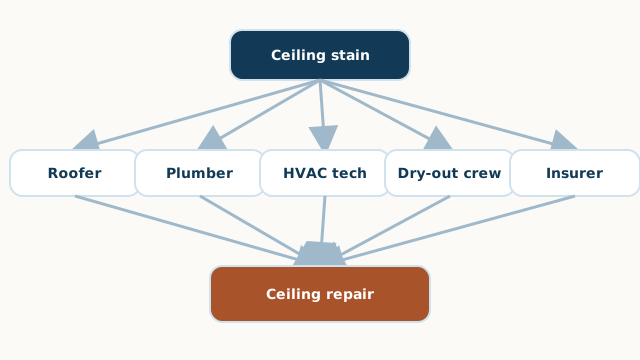
Stop the water and make it safe first. Then call whoever can fix the source: a roofer if it leaks when it rains, a plumber if it leaks without rain, an HVAC technician if it leaks on hot days near the attic unit. Call your insurer if the damage is significant, and a ceiling repair contractor to dry, rebuild and refinish. In a condo, call your neighbor and HOA first.
Before you call anyone: the first ten minutes
None of the phone calls matter if the water is still running or there's a live light fixture in the middle of it.
- Stop the water at the fixture, the shut-off under it, or the main valve.
- Turn off the breaker for any wet light, fan or outlet.
- Get people out from under a bulge, and put a bucket under the drip.
- Take photos and a short video before anything is moved.
If the ceiling is bulging with water, the emergency ceiling leak page covers how to drain it safely.
Who to call, by what you're seeing
The single best clue is when the stain shows up or gets worse. Match yours below.
| What you're seeing | Likely source | Call first |
|---|---|---|
| Stain appears or grows during or after rain | Roof, flashing, skylight, chimney, window | Roofer, or a contractor who traces roof leaks |
| Stain under a bathroom, worse after showers or flushing | Shower pan, valve, drain, toilet seal | Plumber |
| Always damp, water bill up, meter moving | Supply pipe pinhole or fitting | Plumber |
| Only on hot days, near a vent or the attic hatch | AC condensate line or pan | HVAC technician |
| Drips at the bath fan after showers | Condensation in the fan duct | Ceiling contractor or HVAC |
| Water from the unit above (condo) | Neighbor's fixture or a shared line | Neighbor and HOA |
| Old, dry stain that keeps showing through | Past leak, already fixed | Ceiling repair contractor |
| No idea | Unknown | Someone who does leak detection before cutting |
What each trade actually does (and doesn't)
The most common frustration is that every trade fixed its part and nobody fixed the ceiling. Knowing the boundaries upfront avoids that.
Roofer
Finds and repairs the leak on the roof: lifted or cracked tiles, worn underlayment, flashing at walls, chimneys and skylights, pipe boots. Doesn't usually touch the attic insulation or the drywall below.
Plumber
Repairs supply lines, drains, valves, shower pans and toilet seals. Often opens the ceiling to get to the pipe, then leaves the hole for someone else to patch.
HVAC technician
Clears or reroutes the condensate line, replaces a rusted pan, installs or tests a float switch, fixes a freezing coil. The wet ceiling below is outside their scope.
Water mitigation company
Removes water and wet materials and dries the structure with dehumidifiers and air movers, with a moisture log. Many stop there and don't rebuild.
Ceiling repair contractor
Dries and rebuilds the ceiling itself: drywall, tape and finish, texture, primer and paint. A good one also confirms the source is fixed and the cavity is dry before closing it.
Where a ceiling contractor fits: they handle the ceiling side from start to finish, trace the source before cutting, and coordinate the plumbing, roofing or HVAC repair so the ceiling only gets opened once. This site can connect you with one.
Where your insurance company fits in
Call your agent or insurer when the damage is more than a small, cosmetic stain, and ideally before major tear-out, so an adjuster can see it. But don't let the call delay drying. Policies generally require you to take reasonable steps to prevent more damage, and wet drywall can start growing mold within 24 to 48 hours.
Whether it's worth filing at all depends on the cause, your deductible and your claim history. The guide to what California homeowners policies cover explains the sudden-versus-gradual question that decides most ceiling claims.
The order that saves the most time
- Make it safe and stop the water.
- Document it with photos and video.
- Find the source, or have someone trace it before cutting.
- Fix the source while the ceiling is open, then test it.
- Dry it to measured readings.
- Call your insurer early if the damage is significant.
- Rebuild and refinish the ceiling.
Steps 3 through 5 are where most jobs lose time, because each trade waits on the other. Having one person coordinate them is the fix.
Who to call: common questions
Quick answers on plumbers, roofers and insurance.
Should I call a plumber or a roofer for a ceiling leak?
Check the timing. If the stain appeared or grew during or right after rain, start with a roofer. If it changes when it hasn't rained, especially after showers, laundry or toilet use, start with a plumber. If it only happens on hot days, call your HVAC technician about the attic unit's drain.
Does a plumber fix the ceiling too?
Usually not. Most plumbers repair the pipe and leave the opening for someone else. Drywall, texture and paint are a different trade. Ask before the work starts so you know who's closing the hole.
Who do I call first if I don't know where the water is coming from?
If it's actively dripping, stop the water at the main and make it safe first. Then call someone who traces leaks before cutting, so you're not paying a roofer to look at a plumbing problem or the other way around. The ceiling leak detection service does exactly that.
When should I call my insurance company?
Once the water is stopped and you've photographed everything, and before major tear-out where you can. Your policy expects you to prevent further damage, so drying shouldn't wait for an adjuster. A call to your agent first can help you decide whether a claim makes sense.
Do I need a water mitigation company?
For a large or long-running leak, a soaked ceiling, or contaminated water, yes, or a contractor who does the drying. For a small, fresh drip that's been stopped, opening the ceiling, pulling wet insulation and drying with a dehumidifier may be all it needs.
Who do I call in a condo?
Your upstairs neighbor and your HOA or management company first, because the source may be in their unit or a shared line. Then your own insurance agent. The ceiling repair comes after everyone knows where the water started.